
Introducing Fee Canary
A little bird. A clearer trade receipt.
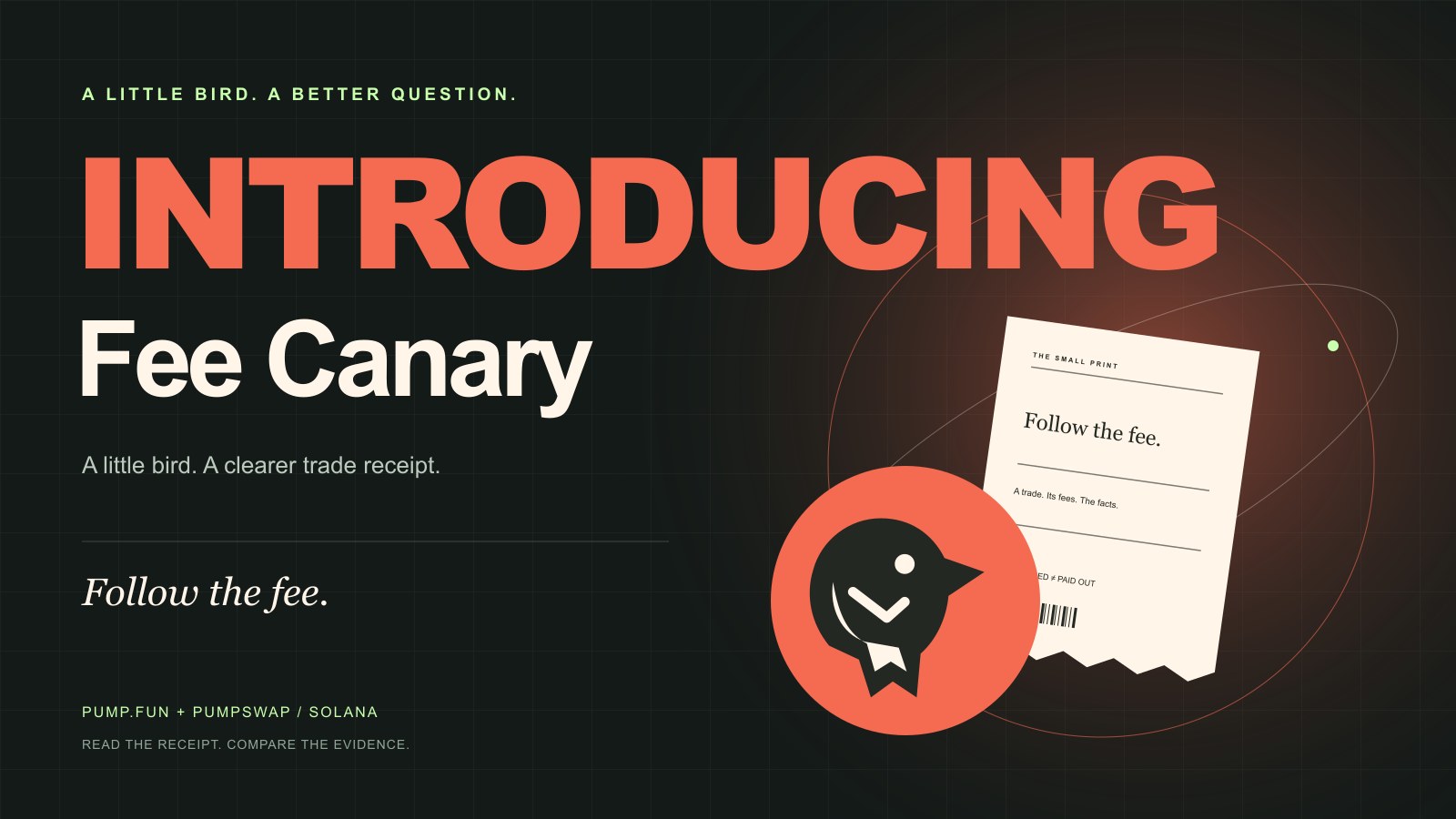
A coin can have a name, a character, a chart and a very good story. A trade has something less glamorous: a receipt. That receipt is where another part of the story lives. What fees did the trade record? Which addresses did the event name? Does a claim about rewards actually follow from that evidence?
Fee Canary begins with those questions. Its invitation is simple: follow the fee.
The thirty-second explanation
Copy a Pump.fun or PumpSwap transaction signature. Paste it into Fee Canary. The tool reads the finalized transaction on Solana mainnet and turns supported trade events into a readable receipt.
You can see the trade direction, the coin and quote asset, the documented fee amounts and the addresses recorded in the event. A separate line shows the whole transaction's network fee. Keep the JSON receipt, follow the explorer link or share a URL that looks up the same transaction.
There is no wallet to connect and nothing to sign. Looking at a public receipt does not require handing over your money.
Why a canary reads the small print
Price charts answer one question extremely well: what happened to the price? They do not, by themselves, explain the economics behind an individual trade. A memorable story can travel further than the details that support it.
Our canary is curious rather than prophetic. It does not predict prices or announce that a token is safe. It leans toward a piece of paper and asks for the details. The folded receipt-tail connects the character to that habit: keep looking, keep the evidence, and ask another question when the receipt stops short.
Coral, paper white and dark ink make a small, coherent world. Paper moves; the words stay readable. The website's motion follows a lookup from signature to chain event to receipt. It does not pretend that decorative movement is live trading activity.
From a signature to a receipt
A transaction signature identifies a particular transaction. It is not a token's mint address or a wallet address. Those identify different things, so the checker asks specifically for the full signature.
The server requests a finalized Solana transaction and examines its execution logs. Supported Pump.fun and PumpSwap events are decoded within the correct program invocations. A transaction that failed does not produce a trade receipt. Events inside a failed invocation are excluded even when a surrounding transaction succeeds.
Fee amounts remain integer strings until they are formatted for display. This matters because a blockchain amount can exceed the range that ordinary JavaScript numbers represent exactly. SOL uses nine decimal places. Other quote assets retain their observed precision; an unresolved asset stays in raw units rather than being relabeled SOL.
The receipt links back to its transaction. It also retains original event fields, the slot, the observation time and any unrecognized trailing bytes. An unknown field stays unknown. A pleasing interface is not a reason to invent an explanation.
One illustrative trade, with deductions kept separate
Here is a hypothetical SOL-paired event, not live activity and not a current fee schedule. Suppose it records a protocol fee of 0.009500000 SOL and a creator fee of 0.003000000 SOL. Suppose the transaction also has a network fee of 0.000005000 SOL.
The two trade-fee fields add to 0.012500000 SOL. Including the separate network fee gives 0.012505000 SOL across these hypothetical fields. That arithmetic does not establish the trader's full cost or proceeds. A transaction may contain other instructions, and a venue's reported trade amount may already include some fees. You would need those details before deducting fees from a quoted sale amount or adding them to a purchase amount.
Fee Canary therefore presents the fields rather than inventing a net-profit number. Additional event allocations, such as buyback or holder rewards, are kept separate: they may describe routing within fees, so adding them again could double count. The example explains how to read a receipt, not how much anyone will earn.
Recorded is not paid out
A creator-fee field establishes what an event reported. It does not establish that a creator later collected the funds, that a sharing configuration distributed them or that an individual holder received a payment.
Pump's creator-fee collection documentation distinguishes bonding-curve and AMM vault collection. Shared configurations have their own distribution path. Fee Canary does not perform those operations or trace their later transfers.
Where an event includes shareholders, the receipt can show the recorded addresses and shares. A recorded share is still not a payment receipt. Verifying a payout would require evidence of the relevant distribution transaction and recipient transfer. This product stops at the trade event and states that boundary.
Where FEECAN fits
FEECAN is the Pump.fun community coin behind the idea of asking for receipts, including our own. Its official Solana mint is 4GpMU7dJ8UWxBuWnCv1qYps4gRVWFFd3R8ZBikwNpump. Copy it using the website's CA button, and check the full address against the official token page.
The checker is open to everyone. Holding FEECAN is not an eligibility requirement and gives no promised yield, payout or ownership right. The useful function is reading public transaction evidence; it does not need an artificial token gate.
If a launch is separately authorized and completed, the exact mint must be published and checked. Its supported trades would be subject to the same rules as any other coin's trades. That is the connection between the coin and the product: the project should be willing to read its own small print.
Pump.fun, Solana and quiet days
The application reads Solana mainnet, not a local simulation or devnet launch. It supports documented Pump.fun bonding-curve trade events and PumpSwap buy/sell events, including supported trades after migration. Other exchanges and incompatible event layouts are outside its scope. The official program documentation describes the launch and migration mechanism.
Nothing needs to trade for the website to remain useful. An existing finalized transaction can still be looked up when its provider makes the data available. Without an input, the checker simply waits for one. There is no counter generating imaginary activity and no trading-dependent reward promised on a quiet day.
What works today, and what does not
The published product includes lookup, fee-field decoding, address links, separate network-fee reporting, JSON export and shareable receipt URLs. Tests cover real buy and sell fixtures for both venues, non-SOL quote handling, precision and important error cases.
It does not offer trading, automatic payouts, vault collection, a token-safety score or a complete audit of every movement in a transaction. Public RPC providers can rate limit requests. Missing transactions, truncated execution logs and unsupported layouts produce errors rather than fabricated results.
Maintaining the reader as program interfaces evolve is ongoing work. The token and the public receipt reader remain separate. Neither is a promise of future financial returns.
Put two receipts next to the story
Receipt Lab adds a second question: what changes between two transactions? Paste two signatures, or load the two clearly marked historical examples, and compare their recorded fee amounts. The tool fetches real finalized records rather than generating a demonstration result.
Differences appear only where the fee category, quote asset and precision match. Missing fields stay missing. Extra allocations are excluded from the comparison, and the whole-transaction network fee remains separate. All arithmetic uses exact integers, including amounts too large for ordinary JavaScript number precision.
A larger amount is not automatically a higher fee rate: the trades may have different sizes. Receipt Lab compares evidence without declaring a winner or inventing a payout. Open either original receipt for the underlying addresses and source.
The interactive walkthrough explains the same path in four steps: signature, finalized record, documented fields and readable output. Select a step or play the sequence. It is an explanation, not simulated trading activity.
Start with one real trade
Open the checker, copy a transaction signature from your wallet history or a Solana explorer, and read the result. Follow its source link when you want more context. Use Download JSON to keep the receipt, or Show receipt link to share the public lookup.
The website's motion gallery shows the visual system separately. The pause control and reduced-motion fallback keep decoration optional.
A short FAQ
Do I need FEECAN or a connected wallet?
No. The reader uses public data and requires neither.
Does a creator fee prove that holders were paid?
No. A payout needs its own transaction evidence.
Does the canary approve a coin?
No. A fee receipt is an observation, not a safety verdict or investment recommendation.
Can I buy the official FEECAN token now?
The official mint is 4GpMU7dJ8UWxBuWnCv1qYps4gRVWFFd3R8ZBikwNpump. Open the Pump.fun token page and verify the full address before interacting. Fee Canary does not execute trades or promise returns.
Everyone can follow a story. Fee Canary gives you a way to read a little further.
Check a trade ↗